The surname ‘Thorp’ is a locational surname that is of Anglo-Saxon and Old Scandinavian origin. People in the Middle Ages used the name of the place they originated from as their surname. Consequently, people who came from any of the places in England that had the Old Norse or Old Danish element ‘thorp’ used this as their surname. ‘Thorp’ in a place name indicates it was originally an area of Danish settlement, with the term meaning a small farmstead or hamlet that was dependent on a nearby village.
Like many surnames, Thorp has several spelling variations including Thorpe, Throp, Thropp and Thrupp. Before English spelling was standardised, variations in the spelling of surnames were common, with elements of Latin, French and other languages being incorporated through the Middle Ages. In addition, scribes and Church Officials commonly spelt surnames the way they sounded, which meant surnames could change several times in a person’s lifetime. The only variation found here was Thorpe.
The research in this report is based on the following information provided by the clients:
Martin Gerald Thorp was born on the 15th September 1931 and was the second of four sons of Sydney Richard Thorp and Elizabeth Margaret (Peggy) née de Moraville. Sydney Richard Thorp was born on the 3rd January 1898, the son of Richard Thorp (born 30th January 1830, died 14th June 1914 and was buried at Wandsworth cemetery) and Clara Emily Soper (born 5th June 1867 and died 18th October 1923). Richard and Clara married on the 2nd March 1898 at Lee, SE London. The couple also had a daughter, Margaret Emily Thorp (born 11 July 1899) who married Russell Gurney. Richard Thorp also had brothers Alfred (a Stockbroker) and William; and sisters Matilda and Frances, the last 3 were unmarried and lived together at Muswell Hill. Copies of several letters of condolence and photos were also supplied by the client.
Research began using the English civil registration records, where since July 1837, it has been a legal requirement to register all births, marriages and deaths. Using these records and some additional information supplied by the clients, the Family Tree shown in Figure 1 has been prepared. The information shown has been amplified in Figures 2 and 3, showing the forebears of Clara Emily Thorp, née Soper, and Elizabeth Margaret (Peggy) Thorp, née de Moraville.
The History as prepared provides mini-biographies of a selection of individuals; those selected have either been born a Thorp, or have become a Thorp by marriage, or are direct descendants of Richard Thorp (1830-1914), who is the main character in this history. A rule is needed otherwise the History could expand without limit. There is no reason why branches of the family may not add to the history themselves by including further biographies.
The report is structured around the family of Sydney and Peggy Thorp and their four children. Reference is made to Sydney and Peggy’s grandchildren, who are now aged around 50, but without giving their detailed biographies; the opportunity exists for further descriptions of their lives and also of their children’s lives. The History then works backwards in time through five generations to Richard Thorp ‘of Spaldington’, who died in 1783 .
The History starts with Richard John Thorp the eldest of the four sons born to Sydney and Peggy Thorp. Richard was born on the 3rd June 1929 at Spring Fort, near Bradfield, Berkshire. He was educated at Beaudesert Park Prep School, near Stroud, winning a scholarship to Marlborough College. At Marlborough he excelled at athletics representing the college in the 100 yards sprint and in the shot putt. In 1946 he joined the Royal Navy and reached the rank of Lieutenant, having served mainly in submarines. Tragically, he was killed when the motor-cycle he was riding was in a collision with a motor-coach in Portsmouth on the evening of 7th February, 1952. He is buried at the Haslar Royal Navy Cemetery, Gosport.

Richard Thorp 1929-1952
The second son, Martin Gerald Thorp was born on the 15th September 1931 at “Bobbins” near Farnham Castle, Surrey. In 1937, Sydney, his father, was posted to Bristol as Adjutant of the Gloucestershire Territorial Association and the family moved to Grove House, Tockington, near Thornbury. Martin followed Richard to Beaudesert Park Prep School around his 8th birthday as war broke out. He remembers ‘digging for victory’ (mostly potatoes) and knitting khaki scarves, which got very narrow as he dropped more stitches! Sydney kept goats to provide milk for the family.
In 1944 Martin entered Marlborough College, following two years after Richard. Martin was a bit of a rebel, but obtained his school certificate, then decided to leave at 17+ to try journalism. His parents had moved to Suffolk because of Peggy’s rheumatism, so he spent a few months at Lowestoft secretarial college. He worked on the Buckingham Advertiser, mostly covering ‘hatches, matches and despatches’.
He then spent two years on Salisbury Plain doing his National Service .
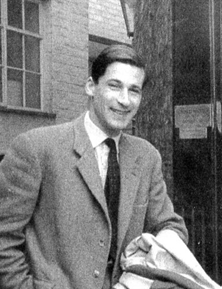
Martin Thorp b. 1931
In 1951 he joined Louis Dreyfus, grain and produce merchants in the City of London and was with them for 3 years. Martin then moved on to Boustead Import/Export and was a manager for them in Malaysia for 10 years. Bousteads were importers for all sorts, from outboard motors to condensed milk and Brylcreem, exporting copra, pepper, palm oil etc. Here he met Anthony Burgess, author of the Clockwork Orange, who refers in that book to the Boustead boys down at Khota Bharu. Worried about ‘going native’, he decided not to return after home leave in 1965. While looking around for a job, he volunteered at Toynbee Hall in Whitechapel, alongside John Profumo and his wife, the actress Valerie Hobson. Living in digs near London Zoo, he recalls picking up a load of elephant dung as compost for the garden !
The following year he joined Trade Indemnity, again in the City, selling credit insurance and bought a flat in Highgate Village. Meeting David Debere over a pub lunch, he was introduced to the Hampstead Garden Suburb badminton club. Two other members were Jimmy Dyson and his daughter Gill. Martin married Gill in North London’s Hampstead Garden Suburb in 1971. He then adopted Gill’s daughter Sarah Louise as his own and together they had a son, Mark James, in 1972.
Martin moved to Tilehurst, Reading, in 1979 to become the local manager for Trade Indemnity. He retired in 1992, continuing to live in Tilehurst.
While living in North London, he stage managed some of the productions for their local drama group. Later interests in life were long distance cycling and table tennis.
Martin died after a short illness in April 2023.
Gillian Mary Thorp, previously Gillian Ramdeholl, née Dyson, was born on the 10th March 1939 in Hampstead Garden Suburb, the daughter of Jimmy and Jean Dyson. She was educated at Froebel Teachers Training College in Roehampton and later taught at Beckford Primary School in West Hampstead. She married Colin Ramdeholl in 1963, having a daughter, Sarah Louise, with him in 1965.

Gill Thorp, née Dyson, b.1939 – with Martin
On moving to Reading, Gill did supply teaching for a few years, while Mark was still at school, before starting a full time job at St. Andrew’s Prep School near Pangbourne. Two of her pupils were Catherine Middleton and her sister Pippa. She left there in 1995, the year her father died, to join Martin in slightly early retirement.
Her main passion, since being born into amateur dramatics (Jean was an excellent actress) was always acting and Reading had its own Progress Theatre. Later interests have been some voluntary work, Tai Chi and helping at her local Methodist Church.
Both Martin and Gill have enjoyed to the full their roles as grandparents to Sarah’s two sons and a daughter and Mark’s three boys.
The third son Charles Henry Thorp was born in Farnham, Surrey on 27th May 1937.
The family moved to the village of Tockington near Bristol just before the outbreak of WW2. WW2 meant food shortages and they rented out the field behind the house to a local farmer in exchange for a daily pint of milk from his cows. Charles often used to go on his bicycle to fetch this – spilling much of the milk on the way home. He used to watch the searchlights spotting the planes over Bristol from his bedroom window as he lay in bed.
He attended a local class in a neighbour’s house until he was old enough to go to school. School involved following Richard and Martin as a boarder to Beaudesert Park Prep School and at age 13 Marlborough College. Charles felt that neither of these schools suited his particular needs.
On leaving school at age 18 he enlisted in the Royal Engineers for 2 years National Service. Here he trained as a vehicle mechanic with the rank of Lance Corporal.

Charles Thorp b. 1937
On demob he embarked on a career in computing being first employed in Hitchin by Hollerith of punched card fame. This was later renamed International Computers and Tabulators. Here he successfully carried out several data projects. In this period a colleague persuaded him to join the local hockey club.
He left ICT in 1963 to work for Kayser Bondor in Baldock. After a short period he moved to nearby Borg Warner, who later moved him to Kenfig in South Wales as supervisor of their data facility there. Charles then moved to Ford Motor Co who had opened an engine plant in Bridgend and continued there until he was offered early retirement in 1992.
In 1963 Charles had met and married Barbara Owen, living first in Letchworth and later in Welwyn, where they had two children, Rebecca (Beccy) Clare, born in 1966, and Richard Michael, born in 1969. The family moved to Bridgend in 1972 and lived there until Barbara died in 2019.
In Bridgend Charles joined the hockey club. He held the post of chairman for a number of years and later became its president. He also joined the Local History Society and was its treasurer for some 10 years. He was a founding member of the Bridgend Civic Trust and was its secretary for some 20 years.
Barbara Mary Thorp, née Owen, was born on 18th April 1939 in Hampstead, London to Gwilym and Mary Owen. When WW2 broke out, the family moved to Hertfordshire and her father Gwilym joined the RAF and served in Burma until the war ended.
Barbara attended the Sacred Heart Covent in Hitchin and then Letchworth College. She then moved on to train as an infant teacher at Brighton College, where she met lifelong friends Sylvia and Pam who were later to become her bridesmaids when she married. Having qualified, she obtained a teaching post in Strathmore School in Hitchin.

Barbara Thorp neé Owen, 1939-2019
Charles and Barbara were married on 28th December 1963 at Hitchin Parish Church. A short while later they moved from their flat in Letchworth to a house in Welwyn. Beccy was born in 1966 followed by Richard in 1969. Beccy’s daughter Eve Mary Goodman was born in 1992.
When the family moved to Bridgend in 1972 Barbara secured a teaching job at Litchard School. When this finished she moved to Fronwen School in Ogmore Vale. She also taught as a supply teacher in a number of local schools.
Her main interests outside of work were her garden and her dogs, including seven corgis. She served on the committee of the South Wales branch of the Hardy Plants Society for several years. She also was on the committee of the Bridgend Civic Trust Society and regularly attended meetings of the Bridgend Local History Society.
Barbara sadly suffered from dementia in later years and died on March 27th 2019
The fourth son Rupert Francis Thorp was born on 3rd March 1942 at Grove House, Tockington near Thornbury in Gloucestershire. When the family moved to Holton in Suffolk, Rupert attended Magnolia House playgroup in Halesworth together with Jonathan Aitken, politician, and Maria Aitken, actress. He then followed his elder brothers to Beaudesert Park and Marlborough College, winning an Exhibition in mathematics to Peterhouse, Cambridge, where he read Mechanical Sciences and Economics.
During a long vacation at Cambridge he and a friend visited Australia on a subsidised package and worked for two months in a steel mill. They then visited the new city of Canberra and spent three days doing a tour of the Snowy Mountain Scheme, which irrigates and provides power to much of New South Wales – a visit which influenced his later choice of career in water engineering. They then hitch-hiked to Cairns in Queensland for a holiday.
While at Cambridge he played hockey, squash and tennis for his college, being captain of the squash team.
In 1964 Rupert joined Binnie and Partners, Consulting Engineers, for a career in Civil Engineering, mainly water-related projects. In 1969 he became Chartered and went on to work mostly on overseas irrigation and drainage projects in Latin America and the Far East.
In 1968 he spent one year in Northern Ireland building a service reservoir; this was just before the troubles. Here he and Jane, whom he had married in 1966, learnt to race an Enterprise dinghy, sailing on Lough Neagh. This was followed by a two-year visit to Panama looking at the feasibility of rice irrigation some 100 miles west of Panama City. The job included looking for a dam site in the rain forest; having found a site, the British Ambassador and his wife paid a visit and swam in the pools; Rupert later told them he had seen some small alligators in another pool downstream. This could have led to a diplomatic incident.
From 1972 to 74 he worked on the Chira-Piura irrigation and drainage project in northern Peru, firstly on a large concrete-lined canal crossing 50 km of desert, and later designing the drainage system for 35,000 ha of cotton. The local town, Piura, had been built up on the cotton trade, exporting the produce to Liverpool; many of the locals had good English names like Houghton, Woodman or McClacken, their ancestors having travelled out there from Liverpool and stayed.
From 1975 Rupert did a series of feasibility studies in Sumatra and East Java on irrigation schemes for rice growing. The first of these was in Banda Aceh, accompanied by Jane and William, aged 3; the locals there had never seen a small white boy with blonde hair before and they all wanted to touch him. Banda Aceh, which is a low-lying coastal town, was later severely damaged by the 2004 tsunami when 130,000 people were killed.
In 1986 he became a Director of the firm and lived in Jakarta as its representative. He joined the Partnership of the firm in 1988, being responsible for the firm’s work in Indonesia and in South America.
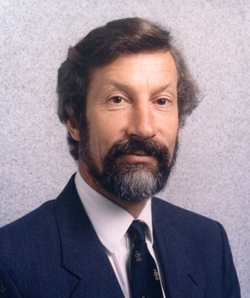
Rupert Thorp b. 1942
While at Cambridge, Rupert met David Miller who taught him to play Association Croquet. Together they started the University croquet team who played the first match against Oxford at the Hurlingham Club in 1964, winning 5-0; croquet subsequently became a “half-blue” sport. David and Rupert were then asked to write a new book on croquet as previous ones were out of date, and out of print. They wrote “Croquet and How to Play it”, which was published by Faber & Faber in 1966 and could be found in most public libraries. In 1977 Rupert helped to found the Chester Croquet Club, providing equipment and copies of the book; he was later invited to become its Honorary President.
Rupert married Rosemary Jane Cooper on the 5th March 1966 at Budleigh Salterton. From 1967 to 1976 Rupert and Jane lived successively in London, Northern Ireland, Panama, Peru and Indonesia, before settling down in Great Barrow near Chester so that Rupert could work in the firm’s Chester office. However he continued to visit Indonesia and Peru until his retirement from the firm in 1993, two years after Jane’s death.
Rupert and Jane had a son William Rupert, born in 1971, who also attended Marlborough College, going on to read Mechanical Engineering at Southampton University. William moved to New Zealand in 1994, doing a postgraduate degree at Auckland University. He married Emma Pitman in 2011 and together they have two children Eddie and Angus, born in 2011 and 2012 in Wellington, NZ. They now live near New Plymouth in North Island, NZ.
In 1994 Rupert married Mary Robinson, a fellow member of Tarvin Tennis Club, who had two sons Howard and Robert from her first marriage. Rupert and Mary then moved to Sunnyside Farmhouse, Brassey Green, near Tarporley.
Following retirement from Binnies, Rupert immediately started volunteer work with the National Trust, advising on numerous engineering projects, including water supply, bridge surveys, hydropower, land drainage and reservoir safety. In 2004 he was invited to become a Member of the North-West Regional Advisory Board, serving for nine years; he was subsequently elected onto Council for three years, where he promoted the need for proper management of its large collection of man-made lakes, many designed by Capability Brown and others. He was the first professional volunteer to work for the Trust and continues in this role, now called a Volunteer Specialist.
From 2015 onwards he assessed the safety of 80 of NT’s smaller man-made lakes (less than 25,000 m3), recommending improvements as necessary; this gave the opportunity to visit many of NT’s spectacular estates.
From 1993 to 1999 he became a Trustee of Barrowmore Village Settlement and Chairman of the Friends of Barrowmore Village Nursing Home, a part of the Settlement. The charity looked after the needs of mentally retarded people of all ages.
From 1998 to 2001 he served as a Director of CLS Care Services, owner of 48 care homes in Cheshire and nearby. In particular he promoted the use of Combined Heat and Power plants within the homes.
From 2001 to 2014 he was a member of Eaton Golf Club Course Committee, being responsible for course drainage and tree management. In 2004 he started the club’s Environmental Working Group, acting as its chairman for 10 years.
From 2014 to 2016 he was a Trustee of the Cheshire Wildlife Trust.
In 2017-19 he was invited by the Institution of Civil Engineers to review their new book on Reservoir Management.
In 2020-21 he assisted the Parish Councils of Huntington and Kelsall in developing drainage schemes for their playing fields.
Later interests in life were tennis, golf (handicap 12), shooting, wood carving and turning, and managing a one-acre woodland planted by Mary and himself in 1996.
Jane Thorp, née Cooper was born in 1943 in Devon and was educated at Northwood School in Middlesex. She later trained as a teacher at the Froebel Institute in Roehampton. After a short spell teaching in the state system she started her own primary school/playgroup in West London. On moving with Rupert to Panama in 1968 she started a school for local and expatriate children aged 3 to 5 in the remote town of Aguadulce, 100 miles west of Panama City. In 1972 she and Rupert moved to Peru, living in Piura near the border with Ecuador; here she started yet another school, which now included William among its 20 or so pupils. Six years later when Rupert re-visited Piura the school was still thriving with over 100 pupils and was referred to as “Mrs Thorp’s Academy”.
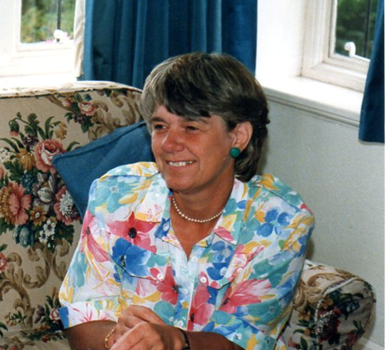
Jane Thorp, née Cooper, 1943-1991
On returning to England and Great Barrow, near Chester, Jane took an active part in village activities, including driving the minibus for the Evergreen Society.
Sadly Jane died while on holiday in New Zealand in 1991 from cerebral malaria contracted whilst she and Rupert visited Indonesia together.
Mary Thorp, previously Mary Robinson, née Chance, was born on 15th December 1941 in a thatched cottage in the village of Radway, Warwickshire. She was educated at Leeds Girls’ High School and took a General degree in Mathematics and Physics at Reading University.
Following this she took an external London degree in Mathematics, gaining 2nd class honours. She married Graham Robinson in 1964 and they had two sons, Howard and Robert. She then worked as a Technical Abstractor with Mullard Research Laboratories in Surrey. When they moved to Cheshire, Mary worked for British Nuclear Fuels in the technical records dept.
After divorcing Graham in 1980 she trained as a secondary school teacher and taught at Rock Ferry High School, then the Hammond School of Dancing as a maths/computer teacher and later at Birkenhead Girls’ High School, being head of the computer department.
In early life Mary was a keen cyclist. In 10-mile time trials she became the fastest woman in Lincolnshire, with an average speed over 20 mph. She was also a keen cycling Youth Hosteller for many years from 1955 until she went to University in 1960. In later life she was a founder member of Tarvin Tennis Club, acting as Treasurer for seven years. After marrying Rupert in 1994 she joined Eaton Golf Club and became Ladies Captain in 2017. She has continued with golf club management, editing and publishing the newsletter and managing the club website.
Her hobbies are golf, tennis, walking, gardening and the Times cryptic crossword; she also enjoys painting in acrylic and playing the piano and the harmonica.
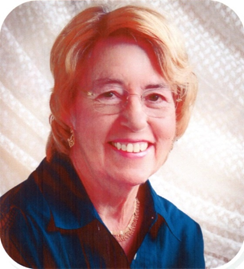
Mary Thorp, née Chance b. 1941
Sydney Richard Thorp was the father of Richard, Martin, Charles and Rupert. He was born on the 3rd January 1898 in Wandsworth, London to Richard Thorp and his wife Clara Emily, née Soper. At the time of the 1901 census, the family were living at ‘Homelea’, Portinscale Road, Putney, Wandsworth. Also listed is Sydney’s younger sister, Margaret Emily, who was also born in Putney, on the 11th July 1899. In addition, the family had 5 servants living at the address, which included two nurses, a cook and a parlour maid.
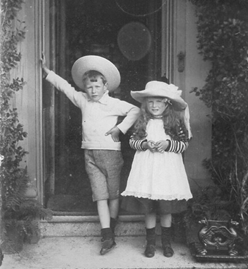
Sydney Richard Thorp with his younger sister Margaret Emily (Peggy) Thorp, c.1905
Ten years later, the family were still living at ‘Homelea’ which, according to the 1911 census, had 14 rooms, not including bathrooms. Four servants are also listed, however Sydney is not listed as he was away at Cheam boarding school, Surrey, where he is listed as being a ‘scholar’ aged 13 years old.
After Cheam School Sydney entered Marlborough College but on the outbreak of war in 1914, moved to the Royal Military Academy, Woolwich, (known as “The Shop”) to be trained as an Artillery Officer. He then served with the 23rd Division of the Royal Field Artillery in France rising to the rank of Lieutenant before being wounded and repatriated. In 1917 he was posted to Gaza, Palestine for the remainder of the war. In 1919 he spent a short time in Alexandria; his main recollection of Alexandria was meeting Lawrence of Arabia in the Officer’s mess and in particular that Lawrence left without paying his mess bill!
From 1919 to 1923 Sydney attended training courses in UK, including a battery commander’s course at Shoeburyness in 1919, and an equitation course at Weedon in 1922. In 1923 he moved to Campbellpore, now Attock, in Western India, now Pakistan. Sydney’s photo album, see Appendix A, illustrates his time spent in Palestine, India, Aden and on training courses.
In 1926 he moved to Jhansi in Central India, where he met and became engaged to Elizabeth Margaret (Peggy) de Moraville.
Sydney and Peggy were married in St Mary’s Church, Streatley in 1928 and moved to Bradfield, where their eldest son, Richard, was born. However, soon after the family moved to ‘Stoney Hatch’, Shortheath Road, Farnham, Surrey where first Martin was born in 1931 and then Charles in 1937.
From 1932 to 1935 Sydney served as Adjutant to the 66th S M Field Brigade of the Royal Field Artillery under Col C.A.H.Fairbank, based in Bristol. Details can be seen in the newspaper cuttings reproduced in Appendix A.
Sydney was posted to Aden in 1936-37, where he was secretary of the Aden Yacht Club.
Sydney retired from the Regular Army in 1937, but re-enlisted with the Territorial Army to command the 249th Battery of the 80th A A Regiment in the Reading Territorial Anti-Aircraft company, in Berkshire, serving again under Col C.A.H.Fairbank.
In 1939 Sydney moved back to Bristol to act as assistant secretary of the Gloucestershire T.A. and Air Force Association.
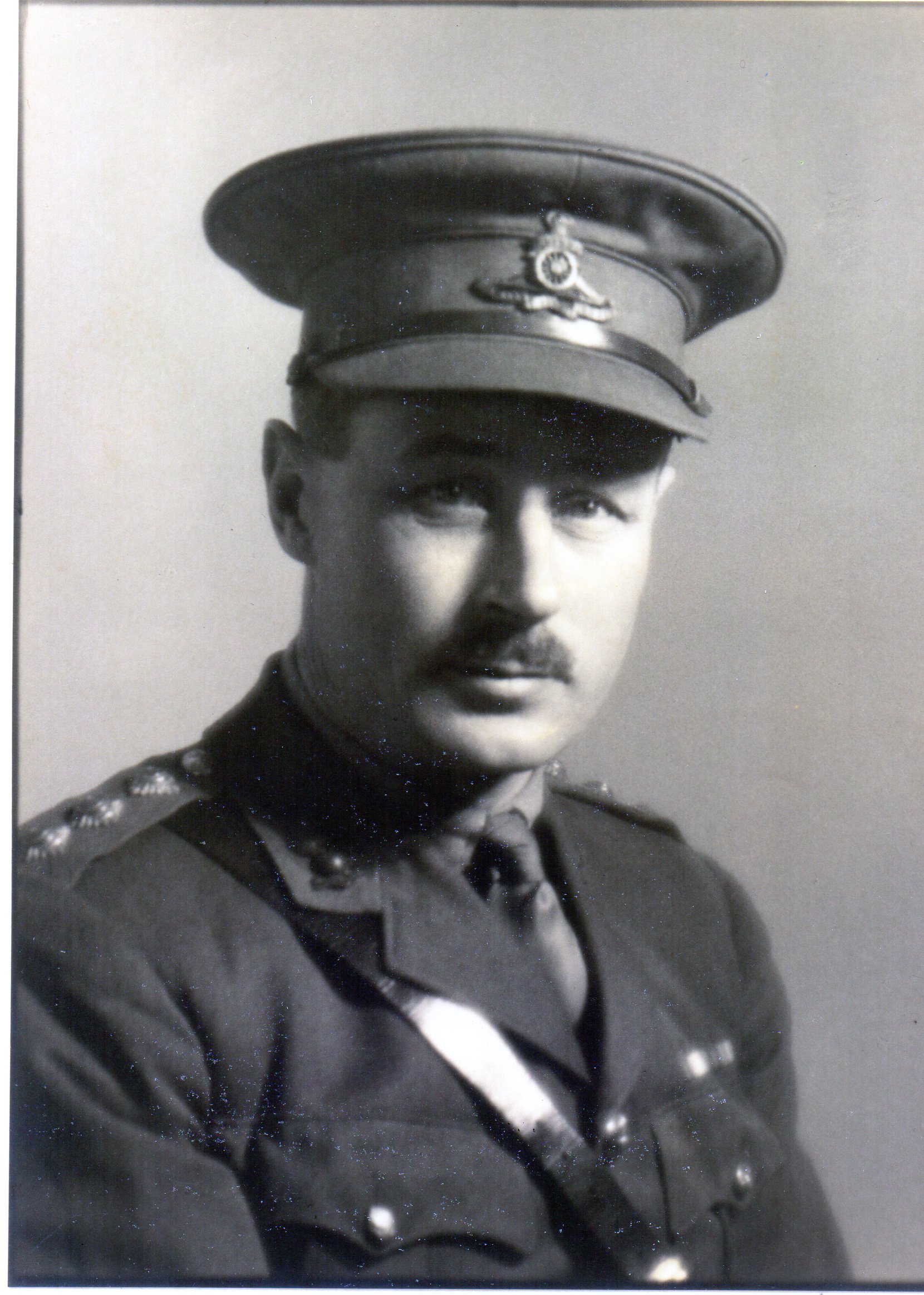
Sydney Richard Thorp, 1898 -1967
At this time Sydney is listed as being a Major in the Territorial Army and served as Adjutant for the Gloucestershire Territorial Association. He continued in the TA until the start of the Second World War. He was then called up again and posted to Scotland in charge of an anti-aircraft battery, where he was given the rank of Acting Lieutenant-Colonel. When Rudolph Hess parachuted into that area in May 1941, he was immediately captured by Sydney’s soldiers and handed over to the police.
The family moved to Grove House, Tockington, Gloucestershire in 1939, see App A, where Rupert was born in 1942. Sydney inherited an old and beautiful Rolls Royce from his uncle, Henry William Dommett Soper, which was the pride of the family but was later sold.
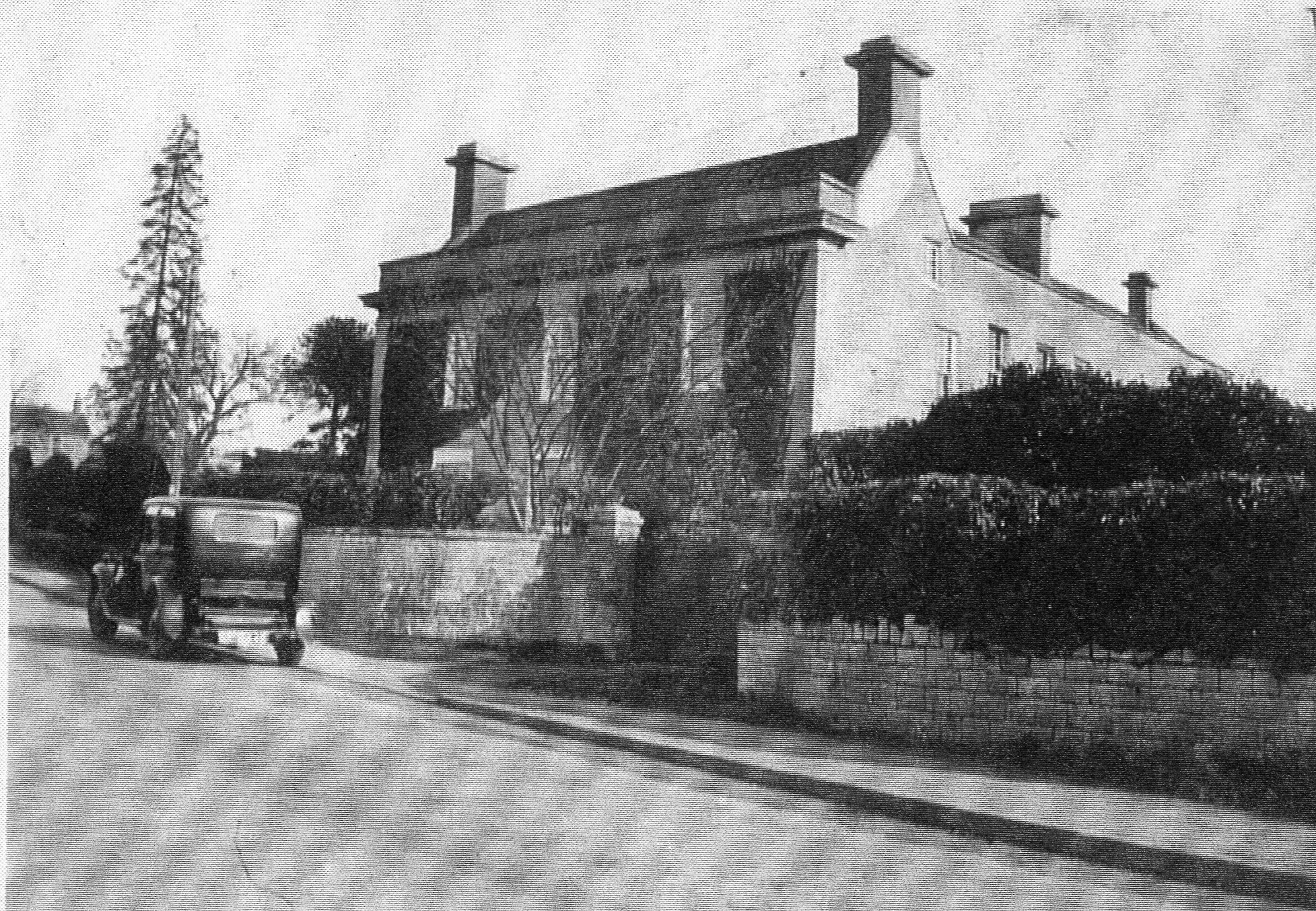
Grove House, Tockington, Glos
In 1947 the family moved to Holton Lodge, Halesworth, Suffolk, principally for Peggy’s health, – Suffolk having a drier climate than Gloucestershire.
In 1952 the family moved to The Old Vicarage, Higham St Mary, in the south of Suffolk so that Peggy could be near her art master, David Cox. At this time Sydney was Secretary of the local branch of the Civil Defence and was involved in rescue work during the East Coast floods of 1953, when the sea rose 5.6m above m.s.l. and 307 people were killed. Sydney also worked with the Soldiers, Sailors and Airman’s Association, SSAFA.
After Peggy died in 1959, Sydney moved to a small cottage nearby at Fengate, Nayland, where he died in August 1967.
Sydney’s wife Elizabeth Margaret (Peggy) Thorp, née de Moraville, was born on the 29th April 1906 at Marylebone, London and was the daughter of John Maximillian Schmidl de Moraville , 1863-17, and Olga Ilma Charlotte, née Behrend , 1872-1947, see Figure 2.
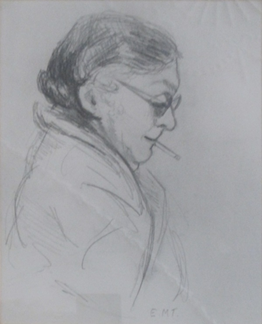
Olga Ilma Charlotte, née Behrend , 1872-1947, drawn by Peggy Thorp (EMT)
As can be seen from Figure 2, Peggy came from a multinational family line. Her paternal grandfather’s family were from Czechoslovakia, where her great grandfather had been doctor to Emperor Franz Josef of Austria. Her maternal grandfather Joseph Behrend came from a line of German forebears, while his wife Rachel, née Mendez da Costa , was of Portuguese extraction, (her family came to London in the C17, see Figure 7 for more details). Peggy’s uncle Louis Behrend and his wife Phyllis Mary, née Sandham, were sponsors to Stanley Spencer, the WW1 artist whose work is now housed in the Sandham Memorial Chapel at Burghclere, owned by the National Trust.
Peggy by all accounts was a colourful young lady who moved in good society, under the guidance of her mother Olga. She was known as an excellent dancer, including ballet – she later suffered from bunions, which is typical of ballet dancers who stand on their points. In 1927 her portrait was painted by Henry Lamb; the painting was loaned by Sydney in 1983 to the Minories Gallery in Colchester but is now kept in Rupert’s house.
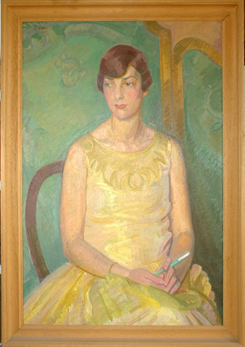
Peggy de Moraville, signed “Lamb 27”
At a young age she had an affair with a well known publisher. He was however deemed to be unsuitable by her mother and so she was shipped off to India to get over him. It was here that she met her husband Sydney.
Peggy’s wedding to Sydney is recorded in a newspaper article Link in the Reading Standard for Saturday June 9th 1928, see Appendix B. She was given away by her brother, Capt John de Moraville, and her bridesmaids included her sister Audrey, her cousin Julia Behrend and a French friend Yvonne Zeigler. Her page was her cousin George Behrend. The article lists all the guests and their presents: Peggy’s present to her husband was a miniature painting of herself, painted by Mrs Eveline Corbould Ellis, reproduced full size, below. The miniature is now held by Rupert Thorp.

Peggy de Moraville, by Eveline Corbould Ellis, 1928
The article also records that her mother afterwards entertained 100 villagers at a dance in Wallingford Lodge and that the honeymoon was spent in Switzerland and Paris.
Peggy’s friend and bridesmaid Yvonne Zeigler was an accomplished oil painter and introduced her to the art. Later in life they shared several holidays together, painting in the Dordogne area of France. Peggy spoke perfect French
Martin recalls: “We were on holiday in Seaton and the beach was studded with concrete blocks etc in case of invasion. Mum decided to paint the beautiful curve of the bay and set up her easel at a high point of the southern end of the cliff overlooking the bay. She had been working for an hour or two when interrupted by the arrival of a police car. She was handcuffed, taken to the police station and deposited in a cell. After some time she was questioned by a police inspector and accused of spying. It required the intervention of Auntie Peggy, Sydney’s sister, and our dad before she could be released. Unsurprisingly, the painting was never finished!”
This was not her only brush with the police. In the 1950’s she went through a phase of copying old masters pictures, a noted one being Pieta by El Greco. On one occasion she was accused of being a forger. The police charged her and she was taken to court in Chelmsford. She was acquitted but only after her son Charles and David Cox, her art tutor, had given evidence. An article on her in the Suffolk Artists website gives a brief resume of her life. It records that she was “an artist in oil and a member of the Ipswich Art Club from 1949 and exhibited from Holton Lodge, nr Halesworth, Suffolk. Her works included in 1949 ‘Fruit and Wine’, in 1950 ‘Still Life’, in 1951 ‘Still Life with Pomegranates’ and ‘Old Studios, Mousehole’, in 1952 ‘Still Life with Fish’ and ‘A Cornish Cove’ and in 1958 ‘Still Life 1957’ and ‘Ramatuelle, South of France’”. Photos of her paintings now held by the family are reproduced in Appendix C.

Elizabeth Margaret (Peggy) Thorp, née de Moraville, 1906-1959
In the early 1950’s Peggy had started attending art classes with David Cox, a descendant of the early C19 landscape painter/impressionist of the same name. David later introduced her to a more modern abstract style of painting. A photographic record of 21 of her works, showing how her style developed, can be seen in Appendix A, below.
David Cox made a Doll’s House for her which was said to be a copy of his own house as a child. She delighted in furnishing it with the help of friends and relatives. One of these was Bobbie Haslewood, a friend from Liverpool, who made an exquisite set of dining table and chairs. Bobbie gave Rupert a set of wood carving tools at this time and he made several pieces for the Doll’s House, mostly copies of furniture in the house. The Doll’s House is now in Rupert’s possession. Details of the rooms can be seen in Appendix D.

Thorp Hall, made by David Cox
Peggy died suddenly in November 1959 at the National Hospital, Queen’s Square, London, as the result of a brain haemorrhage.
Although not a Thorp, Audrey Harvey, née de Moraville, Peggy’s sister, must be included in this history. Not only was she an exceptional person in her own right but also she was always close to Sydney and Peggy’s family, and was a source of great fun for all; her expertise at the card game Racing Demon was seldom surpassed. Audrey, known variously as “Anti” or “See-you”, went to boarding school and then Oxford University where she read English. Her first husband, Patrick was a wine merchant and she had a daughter by him, Ann; her second husband, Ronald Harvey, a distant cousin of Patrick, was an osteopath.
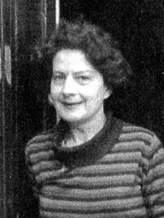
Audrey Harvey, née de Moraville, 1912-1997
Audrey was well known for her work, often voluntary, in the field of housing and homelessness. She worked in a Citizen’s Advice Bureau in Poplar, East London, for many years, writing numerous pamphlets, including one for the Fabian Society, and advising on the TV drama Cathy Come Home. Her obituaries in The Times and the Guardian are reproduced in Appendix E.
Peggy’s younger brother, Capt. John de Moraville M.C., was born in London in 1908 and educated at Oundle and the Royal Military College, Sandhurst, passing into the 4th Queen’s Own Hussars in 1928. The following year he left with his regiment for India. Being an accomplished horse rider, he won 9 races in 1929 and also the £200 Handicap Hurdle at Lucknow the following year.
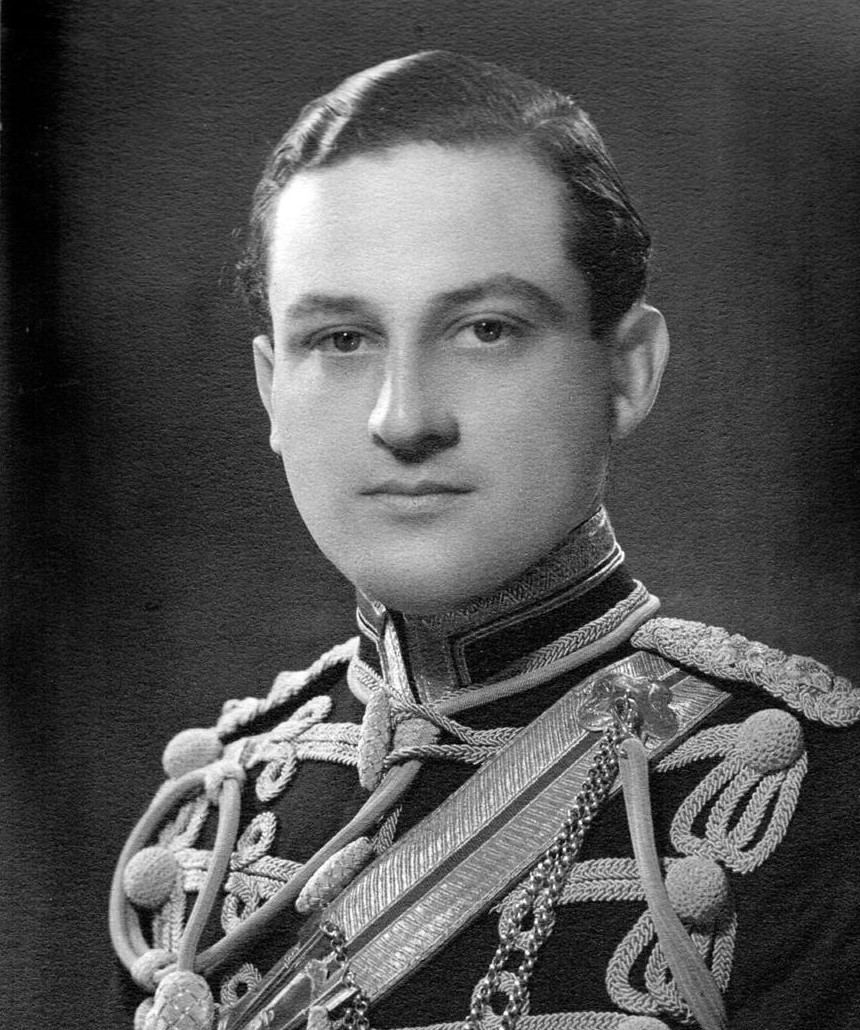
John de Moraville, 1908-1970
He returned from India in 1930 and started training his own horses at Knavesmire race course, York. He had considerable success as an amateur rider and went on to become a trainer. However he had been a trainer for only six months when war broke out.
Serving in the Middle East he was reported wounded and missing in May 1941. Reports for 1942 indicate that he was in the prisoner-of-war camp OflagVB at Bieberach. It is likely that he was awarded the Military Cross at this time, but the circumstances are not known.
After the war he resumed training and an early winner for him—and his three fellow owners was King Penguin ridden by another ex-prisoner ” Dicky ” Black. John and Dicky struck up a successful trainer-rider partnership. One of the most notable horses trained by John de Moraville was the French-bred Vulgan. which won the Queen Alexandra Stakes at Royal Ascot; he also trained the brilliant French-bred chaser Rondo 11.
In 1950 he married Mrs. Joan Bailey, the daughter the late Brig. H. M, Grenfell and the late Lady Muriel Grenfell. They had a son, also John. In 1962 he became the owner and manager of Frethorne Stud, Childrey, Wantage, Berks. He died in Brompton Hospital, London, in 1970.
Sydney’s sister Margaret (Peggy) Emily Gurney, née Thorp, was born in Wandsworth on 11th July 1899 and was then baptised on 13th August 1899 at the Holy Trinity Church in Wandsworth. She and Sydney were brought up at Homelea in Putney, moving with her mother to The Glen in Seaton when her father died. She married Russell Gurney (b 8th October 1890, Swanage) on the 26th April 1928 at St Paul’s Church, Upper Norwood, Croydon.

Margaret (Peggy) Emily Gurney, née Thorp, 1899-1980
Peggy lived the life of a senior army officer’s wife. This meant frequent house moves and being involved in the life of the regiment, in particular looking after the wives of the junior officers and hosting frequent dinner parties.
Peggy gave birth to the first of their two children, Timothy Russell on the 16th June 1929. The following year, the couple are listed in the 1930 electoral register as living at 7 Gordon Road, Frimley, Surrey. This is where their second son, Thomas Jeremy Russell, was born on the 26th June 1934. They later moved to Crownhill, a suburb of Plymouth.
In 1938 they were moved by the army to Ablington, near Amesbury so that Russell could take command of the Small Arms School on Salisbury Plain. Here they lived in style with a large house in a large garden with staff including a gardener, a groom with three horses and a chauffeur; staff inside the house included a cook and various maids. The groom used to take the boys for riding lessons on the Plain. Russell fished in the nearby River Avon.
From there they were moved to Malta for two years which was quickly reduced to two months as Russell was needed in the War Office. After returning to Ablington they moved in 1940 to Hayne House, Bunt’s Lane, Seaton, Devon, from where Russell weekly commuted to London. The house is now known as Richmond Lodge.
Peggy and her family had spent much time as a child in Seaton, her parents visiting there many times from 1898 onwards. On returning to Seaton she took part in the war effort, making camouflage netting and growing potatoes on half an acre of garden.
After Russell’s death in 1947 she spent many years as a widow, but remained active in all her hobbies. Peggy was an expert at needlework, and also enjoyed tapestry. Jeremy recalls that gardening gave her a lot of pleasure and she kept the garden around the house looking beautiful; the vegetable garden and the fruit cage were very productive, and the grapes growing in the greenhouse were delicious.
Later, as she became less well, she transferred to a nursing home in Buckinghamshire, close to Jeremy and his family, where she died on January 30th 1980. She was buried in the churchyard at Seaton, close beside Russell, who had been there for more than 30 years.
Russell Gurney, 1890-1947, was educated at Clifton College, Bristol, and played rugby for Northampton and the East Midlands. During the First World War, he took part in several battles including the Somme and Loos. Following the war, he joined the staff of British troops in Sudan during the Mutiny in Khartoum (1924-25). He joined the Suffolk Regiment in 1928 and spent several years working in the War Office. In 1938, as noted above, Russell was given Command of the Small Arms School at Netheravon.
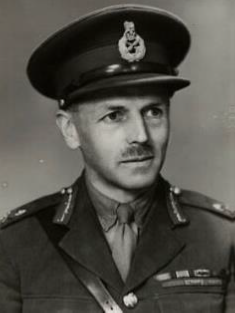
Russell Gurney, 1890-1947
In 1943 Russell was promoted to Major General, Director of Personnel Services in the department of the Adjutant General; in 1944 he became Aide de Camp to the King. He wrote several training manuals and books including ‘History of the Northamptonshire Regiment’ and a spy story called ‘Devil or Man’, in collaboration with Peggy.
He was a keen fly fisherman and highly skilled at DIY tasks such as carpentry and bricklaying. Among other things he built a new greenhouse.
He died in 1947 at ‘The Imperial Nursing Home’ in Cheltenham. He is buried in Seaton, Devon.
Tim Gurney, 1929-2010, was born at Beulah Hill, London, and educated at Beaudesert Park, as were his four Thorp cousins, and then Clifton College, following his father. Following National Service he took a degree in Mechanical Sciences at Peterhouse, Cambridge.
During National Service Tim organised the Army cross-country team; while at Cambridge, he played rugby, squash and tennis, and ran in the 4 x 100yd relay race against Oxford. A favourite activity when visiting his parents in Devon was to go fly-fishing on the River Coly nearby.
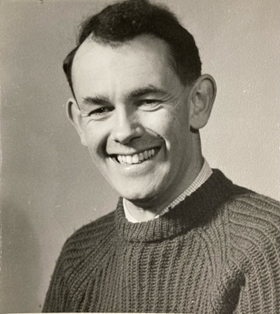
Timothy Russell Gurney, 1929-2010
After leaving Cambridge, he trained as a Civil Engineer with Atkins & Partners, before going on to do postgraduate work in Structures and Strength of Materials at Cambridge. He then joined the British Welding Research Institute for a distinguished career in welding research, completing his Ph D on the fatigue strength of welded materials at Cambridge in 1968. He wrote numerous papers on this subject and contributed to drafting the British Standard Fatigue Design Rules.
Tim married Catherine Ravenscroft at St Mark’s Church, Newnham, Cambridge in 1979. They had two sons, Chris, born 1980 and Alistair, born 1982. After Tim retired in 1994 they moved to the village of Whittlesford, near Cambridge, where Tim wrote a book on “Cumulative Damage of Welded Joints”. Tim was a keen sportsman and gardener throughout his life, and in retirement devoted much time to painting, and organisation of various activities and events in the village.
Jeremy Gurney was born at Frimley, Surrey in 1934 and followed Tim in his education path. After Clifton College he did National Service with the Royal Engineers and then went on to Peterhouse, Cambridge where he was awarded a first class degree in Mechanical Sciences.
While at Peterhouse he took up rowing and joined the “Peterhouse Rugger Boat”. In sixteen “bumps” races over two years, they scored a total of fifteen consecutive bumps, and became known as ‘the ever-successful rugger boat’
He made use of the long vacations firstly by working on a dam as part of the St Lawrence Seaway project and then driving across Canada and the United States to visit Yellowstone National Park, and secondly to work on a motorway project near Stockholm, followed by travel in Norway and Denmark.
Jeremy married Bridget Honor Balkwill at St Winwalloes Church, East Portlemouth, Devon, in 1962. They had three children, Kate, born 1963, Jo, born 1965, and David, born 1967.
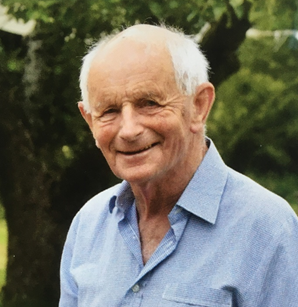
Thomas Jeremy Russell Gurney, 1934-2022
In 1957 he joined Freeman Fox & Partners and worked on numerous notable bridges. The first of these was the Severn Crossing, where a new concept in deck design, the box girder, was developed and later used throughout the world. Work on the bridge foundations was limited by tides to two hour shifts, twice a day at spring tides only.
Jeremy’s next job was as Deputy Resident Engineer for three years on the Tinsley Viaduct, carrying the M1 across the River Don valley at Sheffield. The bridge is double-decked, an unusual feature.
In 1970 he moved to Istanbul with his family to be Resident Engineer building the first bridge across the Bosporus. The box girder concept, developed for the Severn Bridge, was again used and with the foundations on land there were fewer problems and the construction time was shorter. The bridge was well tested when on its opening day large crowds gathered on the bridge, testing it beyond standard traffic loadings. The family travelled home in a camper van through Greece, Italy, Tunisia, Algeria, Morocco, Spain and France.
Back in the London office Jeremy was appointed Principal Engineer on the superstructure of the Humber Bridge, which at 1410 metres was to be the longest span in the world at that time. This was followed by a variety of jobs in the Middle East, Far East and Latin America, all involving travel.
Jeremy retired from the Partnership of Freeman Fox in 1992 and was appointed by Halcrow Consulting Engineers to supervise the construction of a series of bridges linking Hong Kong to its new airport on Lantau Island, working on behalf of the Hong Kong government. Notable amongst these was the Tsing Ma Bridge, which was double-deck for both road and rail and had a total length only a little less than that of the Humber Bridge. Jeremy spent 5 years with his family in Hong Kong.
Following Jeremy’s retirement in 1997, Bridget and Jeremy returned home from Hong Kong in stages on their yacht ‘Halcyon’ and settled in East Portlemouth, near Salcombe, Devon. Jeremy died peacefully at home in November 2022 aged 88.
Richard Thorp, Sydney and Peggy’s father, was born on the 30th January 1830 in Monken Hadley, an ancient country village, north of Barnet. Today the settlement lies on the very edge of the Greater London conurbation. He was baptised on the 28th February 1830 at St Mary’s Parish Church, Monken Hadley.
Information on Richard Thorp derives partly from census returns and partly from a collection of personal items found in a drawer of his dressing table, which was passed to Sydney Thorp and later to Rupert Thorp. It is remarkable that the items have stayed in place since his death in 1914. They include inter alia:
- His silver-bound wallet , containing seven family photos, see App J, a letter from Emily, his wife, dated Nov 3rd 1913 and a photocard of Emily,
- 231 letters from Sydney to his mother Emily from Cheam school, Marlborough College, and RMA, Woolwich, Sept 1907 to Oct 1915
- 108 letters from Peggy/Pegtop/Daisy to her mother Emily from Homelea, Putney, Feb 1905 to Dec 1914,
- Foreign Office passes, issued 1852 and 1885, see App F
- His Travel Record from 1847 to 1911. see App G
- A selection of programmes of G & S operettas and concerts, with various Sopers and Dommetts taking parts,
- The Annual Report of the Penge and Anerley Philanthropic Society, 1914,
- Newspaper descriptions of the funerals and lives of William Dommett d 1878, and Dr H.J.Prangley d 1908,
- A notice concerning the Stock Exchange Benevolent Fund Dinner in May 1884 with Richard Thorp as Chairman, see App H,
- 60 condolence letters and 40 condolence cards to Emily on Richard’s death on 14 June 1914. Also 35 sympathy messages, presumably copied from flowers, see App I.
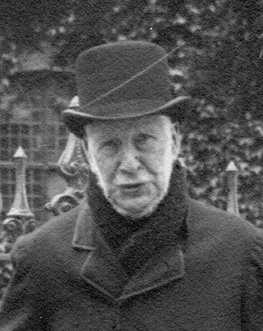
Richard Thorp, 1830 – 1914
Turning to the census returns, it is possible to trace the life of Richard Thorp from the 1841 census up to his death in 1914. The first decennial census of England and Wales was taken in 1801, however, personal information was only recorded from 1841 onwards. The limited amount of personal information recorded in this first census in 1841 tells us that Richard was still living in Hadley, along with his parents William and Frances, plus eight other brothers and sisters: Alfred , Eliza , Maria, Harriet , Louisa , William , Matilda and Emily .
Ten years later, at the time of the 1851 census, the family had moved to Exeter. However the census states that Richard remained in London, staying with his ‘cousin’ Mary Emma Lynn – a 38 yr old ‘Fund Holder’, born in Wickham, Suffolk. The address is listed as being 27 Portland Terrace, Marylebone and Richard is listed as working in the ‘Stock Exchange’. Further research shows that Richard was in fact living with his cousin Robert Jacob Booth at No 27 and that Mary Emma Lynn lived next door at No 26 with her 15 yr old orphaned niece, Susanna Lyon. Robert Jacob Booth was an auctioneer, as was his father, Robert Booth. The latter was an elder brother to Frances Booth, Richard Thorp’s mother. The connections are shown in Figure 5, The Forebears of Frances Thorp, née Booth.
In 1852 Richard obtained a Foreign Office Pass for “travelling on the continent”; this was stamped in Aachen in September of that year, indicating that he visited Germany, see App F. This is confirmed in the personal record of his travels when he recorded that he had visited the Rhine and Belgium, see App G.
Richard married his first wife, Helen Eyre, in Lewisham in October 1855. The same Foreign Office Pass records that Richard and his new bride Helen visited France in November of the same year, possibly on their honeymoon.
Helen was born on the 24th November 1822 in Maidstone, Kent, to Daniel Eyre (1778-1855), a surgeon and his wife Eliza, nee Price (1792-1846). Following the death of Helen’s parents, Richard and Helen moved into her family home at 5 Lee Place, Lee, Lewisham. This is where the couple are listed as living at the time of the 1861 census. Richard is listed as being aged 31 and a ‘member of the Stock Exchange’, while Helen is aged 37. The couple had 2 servants living with them at the time.
Between 1861 and 1871, the couple moved to 12 Manor Park, Lee. Richard is now aged 41 and is again listed as being a ‘member of the Stock Exchange’. Helen is listed as being aged 48 and also had her sister, Eliza Eyre, living with them along with 2 servants. By the time of the 1881 census, the couple had moved again into what was to become the family home for rest of their lives – ‘Homelea’ in Portinscale Road, Wandsworth. Richard was again listed as being a ‘member of the Stock Exchange’ and Helen’s sister, Eliza Eyre, was still living with the couple along with 3 servants. Family folk lore suggests that Richard was ‘Secretary of the Stock Exchange’; no evidence has however been seen of this but there is no doubt that he was Chairman of the Stock Exchange Benevolent Fund, whose Annual Dinner he chaired on 7th May 1884, see App H. In 1881 he was appointed as a Governor of St George’s Hospital, as recorded in a condolence letter from its Secretary to Emily, see App I.

Richard and Helen Thorp on Seaton beach, c.1890. Is Emily one of the young ladies?
Richard does not appear on the 1891 census. Despite Richard still being alive, his wife, Helen, now aged 69, is listed as being the ‘Head’ of the household, living at ‘Homelea’. At the time, she had a 40-year-old ‘companion’ called Rose Hammon from Switzerland and a 40-year-old ‘visitor’ by the name of Alice Cheeseman staying with her. The reason for Richard’s absence was that he was travelling overseas. A second Foreign Office Pass, was issued in February 1885, which was stamped in November 1886 in Russia, and again in January 1891 in Turkey, see App F. These travels are confirmed in his travel record, see App G. Indeed according to his records, he was overseas every year from 1886 to 1896, travelling extensively in Europe and North Africa. In 1894 he visited the West Indies and Guatemala. The reason for all his travels is not clear; it has been speculated that he may have been travelling on behalf of the diplomatic service. Alternatively he may simply have been on pleasure cruises.
Helen died in the last few months of 1892 in Wandsworth aged 70, probably while Richard was away.
Five years later Richard, then aged 67, married Clara Emily Soper in Lewisham. Emily was born on the 5th June 1867 and was the daughter of Henry Coles Soper and Clara Claxton Dommett, see Figure 3. Emily had been born and brought up in Lee, Lewisham, while Richard and Helen Thorp were living there and it is likely that the Soper and Thorp families knew each other well. Richard was the same age as her father, both being born in 1830.
The wedding was on March 2nd 1897, followed by a honeymoon over 7 days in Bournemouth. They then travelled extensively on the continent, visiting the French Riviera, also Italy and Switzerland. Following the wedding, Emily moved into ‘Homelea’ with Richard and gave birth to their first child, Sydney Richard, a year later, on 3rd January 1898. Margaret Emily (Peggy) was then born on the 11th July 1899.
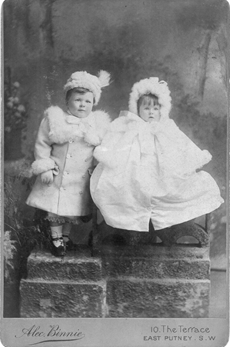
Sydney Richard and Emily Margaret (Peggy), c.1901
Emily’s uncle, Charles William Dommett, came from a family of solicitors based in Chard in Somerset. One of their nearest seaside towns was Seaton, just across the border in South Devon and it is likely that Emily was a frequent visitor there. After marrying Richard in 1897 Richard’s travel record shows that he visited Seaton almost every year from that date until his death.
As previously stated, the family were listed as living at ‘Homelea’ at both the 1901 and 1911 censuses, with the 1911 census being the latest census return open to the public. In the 1901 census, Richard is listed as being a ‘retired member of the Stock Exchange’ and in 1911 a ‘retired dealer of the Stock Exchange’.
Martin reports from a visit that “Auntie Peggy, Sydney’s sister, recalled that her father (i.e. Richard Thorp) used to hold some important position on the stock exchange, but on retirement moved to Seaton and the family went to church on Sundays. He was a large man with a voluminous white beard. He made a habit of timing the sermon and if he thought it was too long or boring, he would stand up, produce a large, white handkerchief and give a loud trumpeting nose-blow. Auntie Peggy found this so embarrassing that she cringed below the level of the pew and hoped nobody would see she was present”.
Richard died on the 14th June, 1914, and was buried at Wandsworth Cemetery. Following his death, Emily received 60 condolence letters, including the one below. There was some doubt as to who wrote this letter as the signature was unclear. In the letter it refers to the writer as being ‘his eldest nephew’. The letter was in fact written by Alfred Thorp (b 1866) who was the son of one of Richard’s brothers – Alfred Thorp (1827-1901), see Figure 1. Alfred actually had an older brother called Frederick, so it is unclear why he refers to himself as being the ‘eldest nephew’. However, proof of the fact Alfred wrote the letter comes in the form of the signature at the bottom of Alfred’s application to be admitted to the Freedom of the City of London on the 2nd August, 1905.
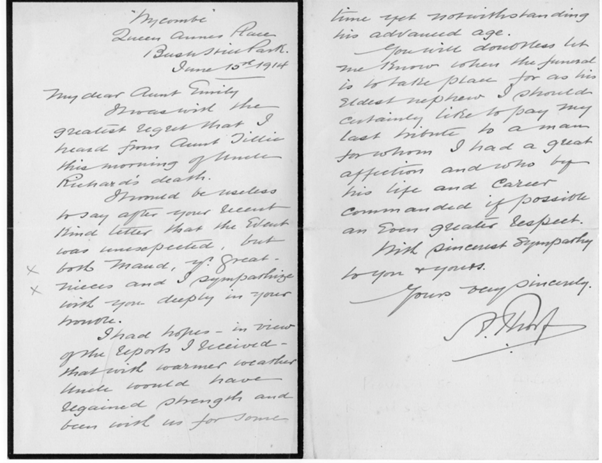
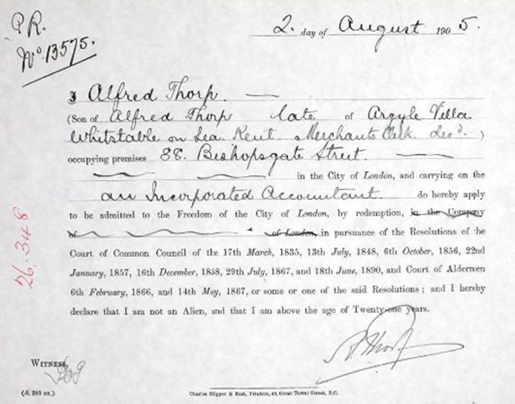
Alfred Thorp’s application to be admitted to the Freedom of the City of London – 1905
Further condolence letters from family are shown in Appendix I, in particular from Frederick Thorp (nephew), Minnie Lenton (niece), Matilda (sister), and Frank Fox, uncle to Emily, see Figure 3.
Letters were also found from the Secretary of St George’s Hospital indicating that Richard had been a Governor from 1881; from the Chaplain of St Edward’s School, Godalming; from the Secretary of the City Carlton Club, indicating that he was a member for upwards of 35 years; and from Robert Harrison, a friend of 50 years standing and a fellow Committee member of St George’s Hospital.
Numerous other letters were received from friends and relatives of both Richard and Emily, who was often affectionately referred to as ‘Mamie’.
Clara Emily Thorp, née Soper, born 1867, was the eldest child of Henry Coles Soper and Clara Claxton Dommett, see Figure 3. She married Richard Thorp in 1897.
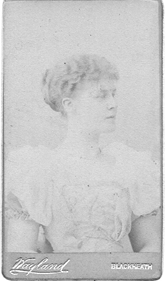
Clara Emily Thorp née Soper, 1867 – 1923
Her father Henry Coles Soper was a silk merchant, as was his father Henry Soper. Their company wove the silk for Queen Victoria’s wedding dress.
Henry Soper’s brother and father, both with the name William, were grocers in Bethnall Green. Emily’s maternal uncle, Charles William Dommett, was a solicitor in Chard.
Before marrying Richard, Emily Soper was one of several members of the Soper family who took part in the Blackheath Amateur Operatic Society’s performances in 1893 and 1894. These included The Gondoliers, The Pirates of Penzance, Patience, and HMS Pinafore. In addition she sang in concerts for the Penge Church of England Temperance Society and for Bethnall House, which may have been a private “madhouse”. Members of her family taking part in the performances were Henry Dommett Soper (brother), Arthur W Soper (brother), Miss E Dommett (cousin), and William Coles (great uncle).
The Soper/Dommett/Thorp family were also strong supporters of the Penge and Anerley Philanthropic Society, which raised funds to support disadvantaged members of society. In its Annual Report for 1914 C W Dommett (Emily’s uncle), Henry Dommett(brother), and Arthur Walrond (brother), are mentioned as Vice-Presidents, the latter two being Past-Presidents, and Richard Thorp and W E Thorp, uncle, are mentioned as donors. A Bonar Law MP, who later went on to be Prime Minister, was also a Vice-President.
Following the death of Richard in 1914, Clara Emily sold Homelea in Portinscale Road and moved down to Devon, purchasing ‘The Glen’, Seaton. Here she took an active part in local life, supported by her daughter, Emily (Peggy).

The Glen, Seaton Hole, in 1940
In August 1916 a well supported and lively fete was held in the grounds of The Glen, raising funds for Seaton War Hospital Depot & Lawn Tennis & Cricket Club. On August 25th 1916 the Exeter and Plymouth Gazette published a long description of events with Mrs Thorp putting the ‘services of herself, family and friends at the disposal of the committee’. They raised £100. Further details can be seen in Appendix L.
According to the Western Times Emily’s health started to fail in 1920 and she was prevented by illness from attending a meeting in May 1920 of the Seaton and Beer Nursing Association, where she was Honorary Secretary. She resigned from that post in May 1923.
Emily died on the 18th October 1923. One would expect that she would have been buried in St Gregory’s churchyard, Seaton, but no marked grave could be found; it is possible she was buried in Wandsworth cemetery to be near Richard. Her Funeral Notice in the Exeter and Plymouth Gazette for 26th October indicated that amongst her close relatives her two brothers H. Dommett-Soper (sic) and Dr Arthur Soper were present, also her cousins Major V. V. Kyrke D.S.O. Messrs G. V. Kyrke, W. Dommett, and F. Grover, Sir John Towse, Miss Towse, Mr J. Poynty Burcell, (Bickley) . Her son Sydney was in India at this time; it is surprising that her daughter Peggy is not mentioned.
In her Will, see App K, she left The Glen to Sydney her son, and Peggy continued to live there until her marriage in 1928. From 1923 to 1928 Sydney was in India, so he would have spent little time at The Glen. He is however recorded as playing in a tennis tournament in Seaton in 1925, presumably between his two periods of duty in that country. The Land Registry records that Sydney purchased the freehold of The Glen from Lord Clinton, the local landowner in 1924; presumably his father had simply bought the leasehold and Sydney wished to be sure he could sell the property as one unit.
Following Peggy’s marriage her uncles Henry William Dommett Soper and Arthur Walrond Soper used The Glen as a holiday home until their deaths in 1937 and 1936 respectively. Sydney Thorp parted with the house in 1943, selling it to a London company, Ganwick Estates Ltd., which converted it into flats
According to the census returns, Richard Thorp’s parents were William Thorp and Frances Booth, see Figures 1, 4 and 5. William is listed as being born in the village of Bubwith, Yorkshire, in 1795. Bubwith is a small village on the east bank of the River Derwent, six miles north east of Selby. According to A.D. Mills’ book ‘A Dictionary of British Place Names’, the village name means ‘Bubba’s Wood’, with ‘Bubba’ being a Scandinavian male name.
William Thorp was born in 1795, the youngest of six children: Ruth bp.1785, Margaret bp.1786, Thomas bp.1789, Robert bp.1789, Sarah bp.1792. His parents were Richard Thorp, bp.1757 and Rachel, née Hayton, b. 1757. He married Frances Booth on the 18th August, 1824 at St John’s church, Hackney. At the time, William was listed as living in the parish of Monken Hadley. The couple then went on to have 10 children, all born in the Hadley parish: Alfred, b 1827, Eliza, b 1828, Richard b 1830, Harriet, b 1834, Louisa, b 1835, William, b 1837, Matilda, b 1839, Emily, b 1841, Frances, b 1843, Mary Ann, b 1845.
On the 1841 census, William is listed as being 46 years old and a ‘Brewer and Malter’. William is also listed as being a ‘Brewer’ in the parish register entries for the baptism of several of his children. His partner in the brewery was his elder brother Robert; the business passed to his nephew Robert Hayton Thorp on his death.
At some point after the birth of their last child, Mary Ann, the family moved down to Devon as they are listed as living at 14 Radnor Place, Exeter St Leonard by the time of the 1851 census. At this time, William’s occupation is listed as being a ‘Proprietor of Houses’.
Ten years later, William and Frances had returned to London and on the 1861 census, they are listed as living at their eldest son Alfred’s house at 1 Bedford Place, Mare Street, South Hackney. Alfred is listed as being aged 34 and a ‘Merchant’s Clerk’. No occupation is listed for William, who was then aged 66. Also living at the address were 3 of Alfred’s sisters – Harriet (aged 27), Emily (aged 20) and Mary Ann (aged 16) – and Alfred’s brother William (age 24) who was listed as being a ‘Stockbroker’s Clerk’.
According to the electoral register of 1862, William was then living at York Terrace, De Beauvoir Town, Hackney. Four years later, in 1866, William passed away and was buried on 13th July at the St John of Jerusalem Church, Hackney. At the time of his death he was listed as living on St Philip’s Road, Dalston.
William’s wife, Frances Booth, was born in 1800, also the youngest of six children: Joseph b.1780, Eady b.1782, Patty b.1784, Robert b.1786 and William b. 1795 . Her parents were Jacob Booth, b. 1747 and Eady, née Sargeant, b. 1756/57. On the 1851 census, she is listed as being born in Tower Hamlets, although on the 1861 and 1871 censuses, it simply states ‘Middlesex, London’.
Following William’s death, Frances lived with several of her now grown up children at Graham Road, St Johns, Hackney, where she is listed as living at the time of the 1871 census. She then passed away in 1877 and is also buried at St John of Jerusalem Church on 13th March 1877.
William’s father, Richard Thorp, 1757-1844, was born in Blacktoft, near Goole in East Yorks, in 1757, the seventh of eight siblings. He married Rachel Hayton in 1784 in Howden, five miles distant, and then went to farm at Higham Park, Northants, until Rachel died in 1828, being buried at Souldrop, close by in Bedfordshire. In 1829 he moved to farm at Knotting Fox, also Northants. He died and was buried also at Souldrop, in 1844.
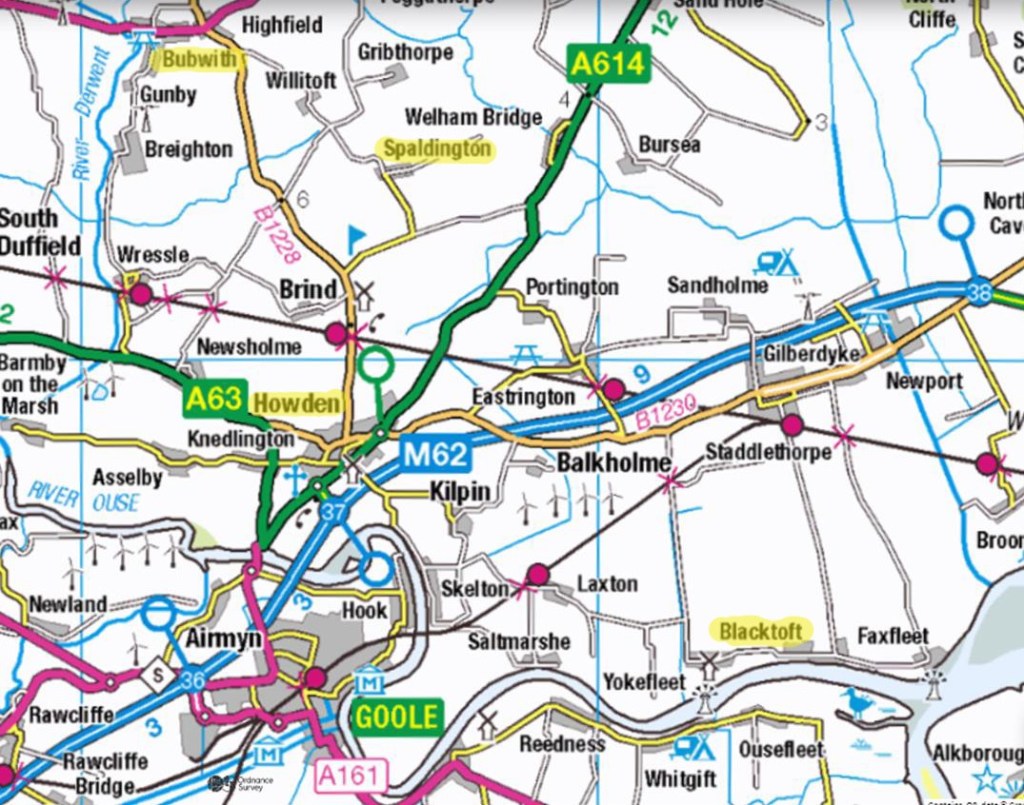
Map of Villages near Goole, including Spaldington, Bubwith, Howden and Blacktoft
Richard Thorp’s father, another Richard Thorp, d. 1783, was known as “Richard Thorp, Farmer of Spaldington”, see above. In 1742 he married Margaret Guy, who was born in Bubwith in 1721; Bubwith is 3 miles from Spaldington. Margaret died in 1783 and is buried in Foxfleet, Howden. Richard died six weeks after Margaret and is also buried in Howden.
At the beginning of the report, reference was made to the variation in the spelling of the surname Thorp. Several examples where ‘Thorp’ was mis-spelt came to light during the course of the research for this report. For example, the parish record for the baptism of Eliza Thorp – another of William and Frances’ children clearly shows the surname being recorded as ‘Thorpe’:
Date Child’s Parent’s Surname Abode Profession Who performed (1928) Name Names the ceremony

Taken from the Parish Records of St Mary’s Parish Church, Monken Hadley
When two more of William and Frances’ children – Frances and Mary Ann – were baptised in 1845, the surname again appears as ‘Thorpe’:
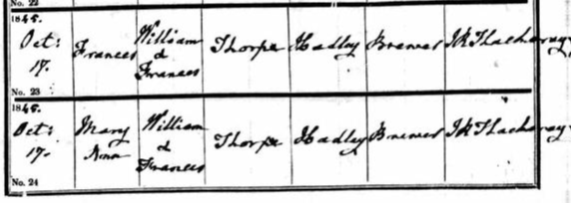
Taken from the Parish Records of St Mary’s Parish Church, Monken Hadley
Having been able to trace the ancestry back seven generations from the clients to Richard Thorp of Spaldington, who was born in about 1720 and died in 1783, research has now come to a halt.
Other avenues to explore could involve looking into the lives of William and Frances’ other children. These include Alfred Thorp, 1826-1901, who was Richard’s elder brother. As shown in Figure 1, Alfred married Susanna Gurner in 1862 in Holborn and they had six children and nine grandchildren. Their second son, also called Alfred, wrote the condolence letter shown above.
Acknowledgements.
My thanks are due to the following who have contributed to this history:
- Tim Gurney, 1929-2010, whose family tree running to some 12 detailed pages, has shown how the Thorp, Gurney, Soper, Dommett and Venables Kyrke families link together, including details of each individual when available.
- Anna Philpott, author of “A History of White Cliff Glen”, a history of the house at Seaton owned by the Thorp family from 1910 to at least 1939, prepared for the Axmouth Vale History Association. Published *****.
- My brother Martin and his wife Gill, and my brother Charles, who have provided recollections from their pasts, and photos of some of Peggy Thorp’s paintings.
- My cousin Jeremy Gurney who has provided recollections from his and from his parents’ past.
- Amanda Webb and Tiggy Wiley-Scott, who have provided photos of some of Peggy Thorp’s paintings.
Martin Booy, Explore Your Past, March 2019,
Rupert Thorp, December 2021
Figures
Figure 1: The Thorp Family Tree
Figure 2: Forebears of Elizabeth Margaret Thorp (Peggy) Thorp, née de Moraville
Figure 3: Forebears of Clara Emily Thorp, née Soper
Figure 4. Extensions to the Thorp Family Tree
Figure 5. Forebears of Frances Thorp née Booth
Figure 7. The Da Costa Family Tree
Appendices
Appendix A: Sydney Thorp’s photo album
Appendix B: Wedding of Sydney Thorp to Peggy de Moraville
Appendix C: Paintings by Elizabeth Margaret (Peggy) Thorp
Appendix D. “Thorp Hall” Doll’s House
Appendix E: Obituaries of Audrey Harvey and John de Moraville
Appendix F: Foreign Office passes issued to Richard Thorp, 1852 and 1885
Appendix G: Richard Thorp’s Travel Record, 1847 to 1911.
Appendix H: Miscellaneous Items
Appendix I: Condolence Letters , 1914
Appendix J: Photos found in Richard Thorp’s wallet
Appendix K: Wills of Richard Thorp, 1830-1914, and Emily Thorp, 1867-1923
Appendix L: Will of Richard Thorp, 1757 – 1844
Appendix M: History of The Glen, Seaton, by Anna Philpott. Part 4.
Appendix N: Thorp, Booth and Sargeant
 Thorp Family History